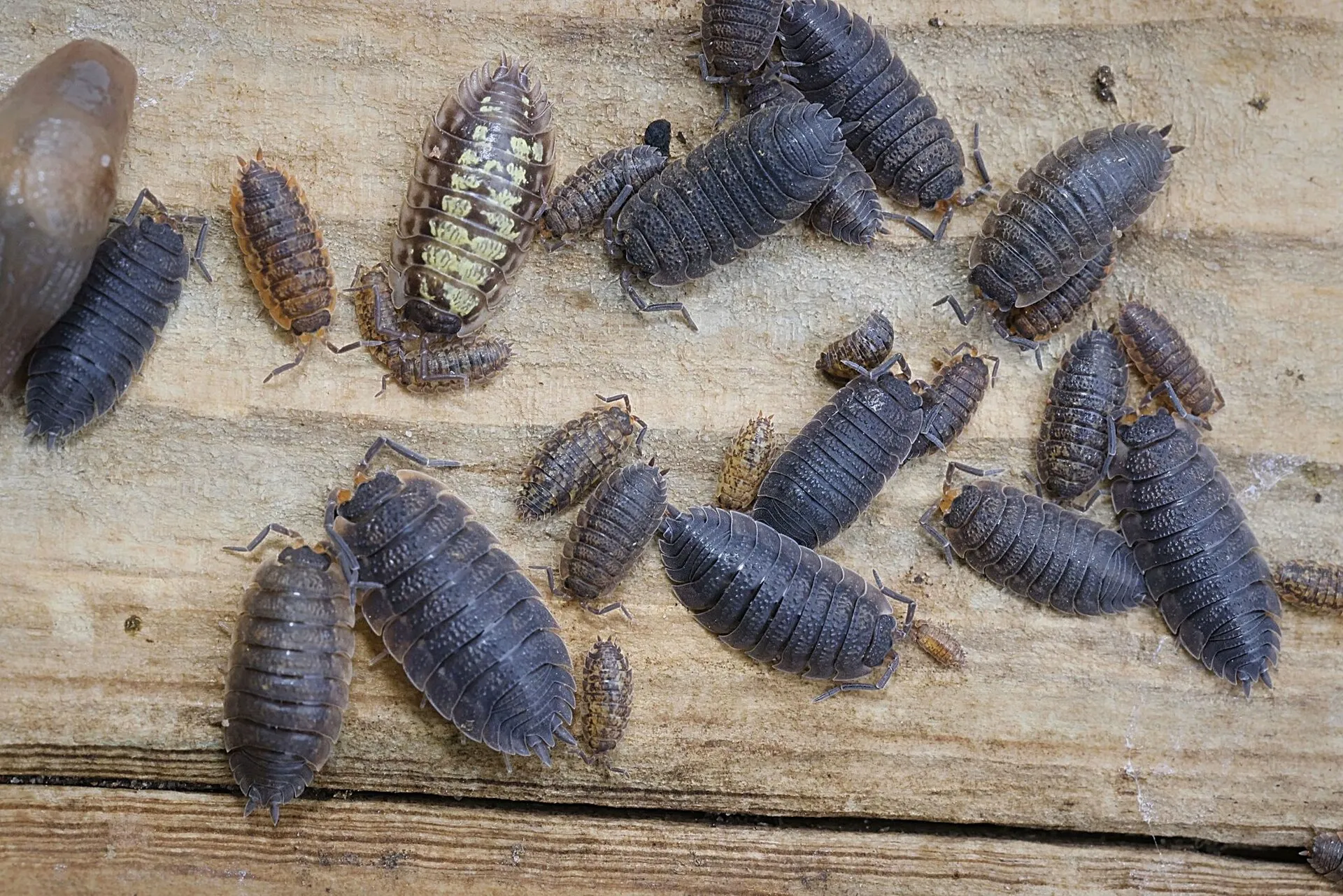
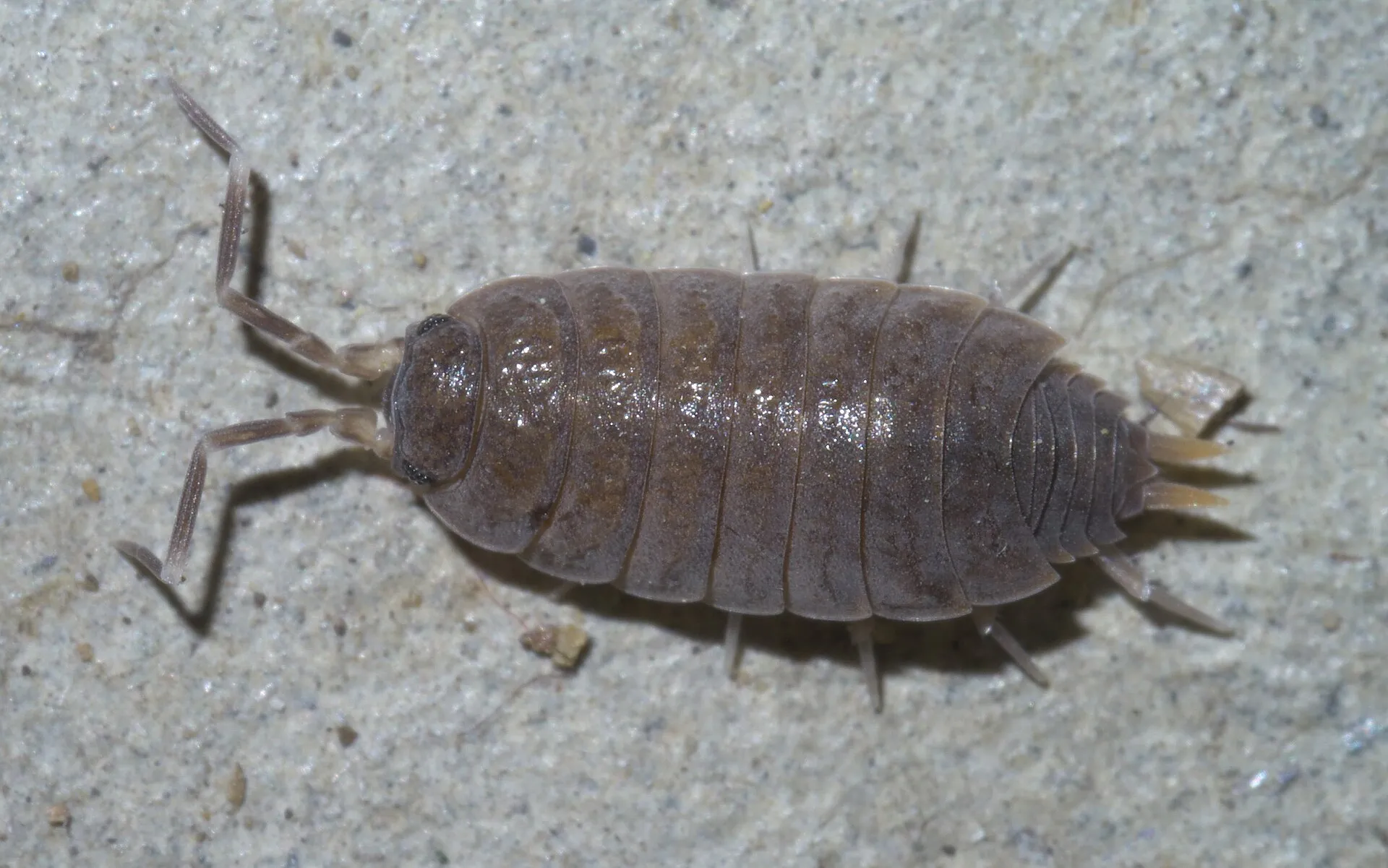
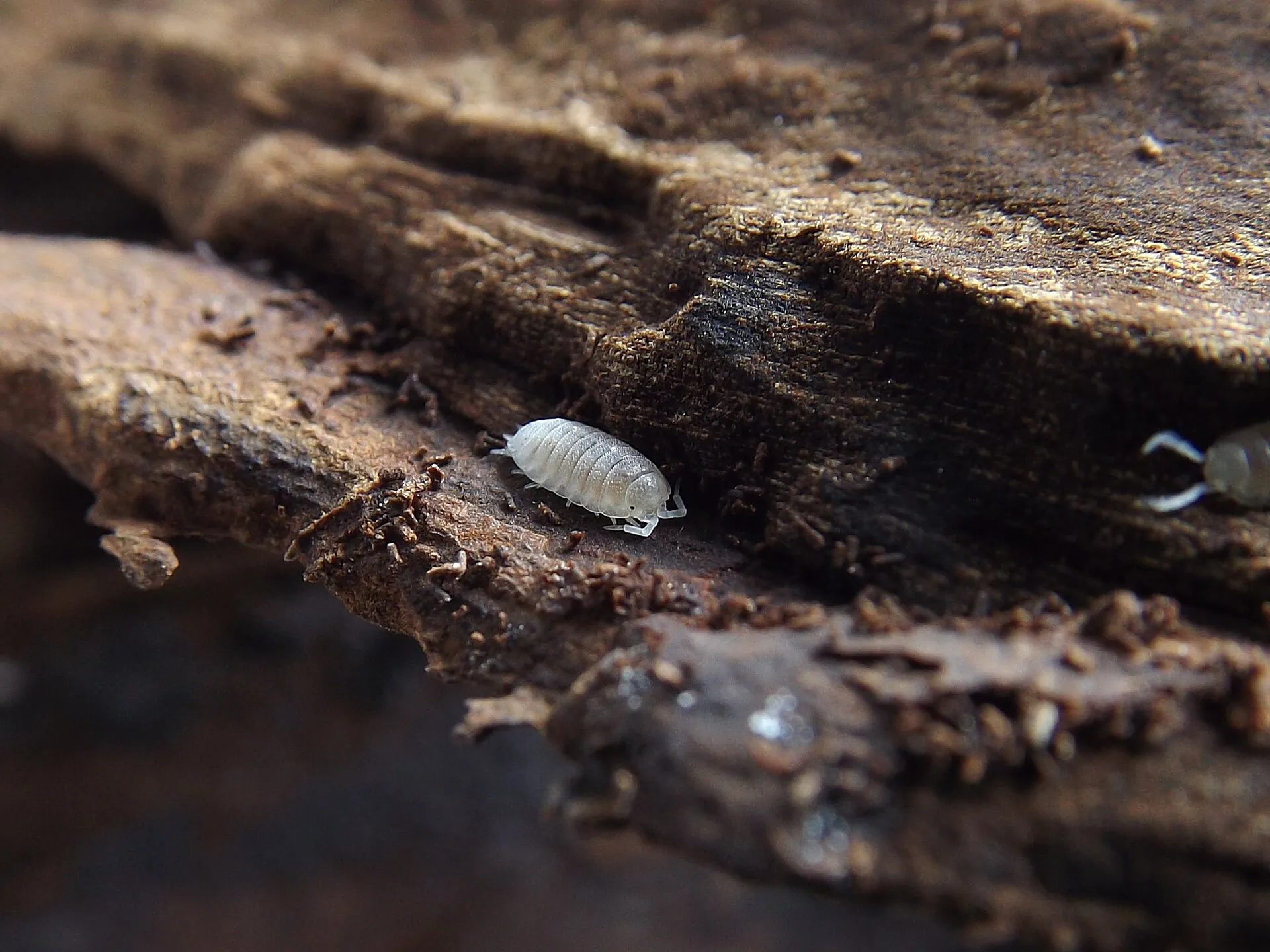
Powder Orange and Powder Blue Isopod Care
How to care for powder orange and powder blue isopods (Porcellionides pruinosus): what the color forms are, temperature, humidity, ventilation, food, calcium, breeding and where they fit in a bioactive enclosure.
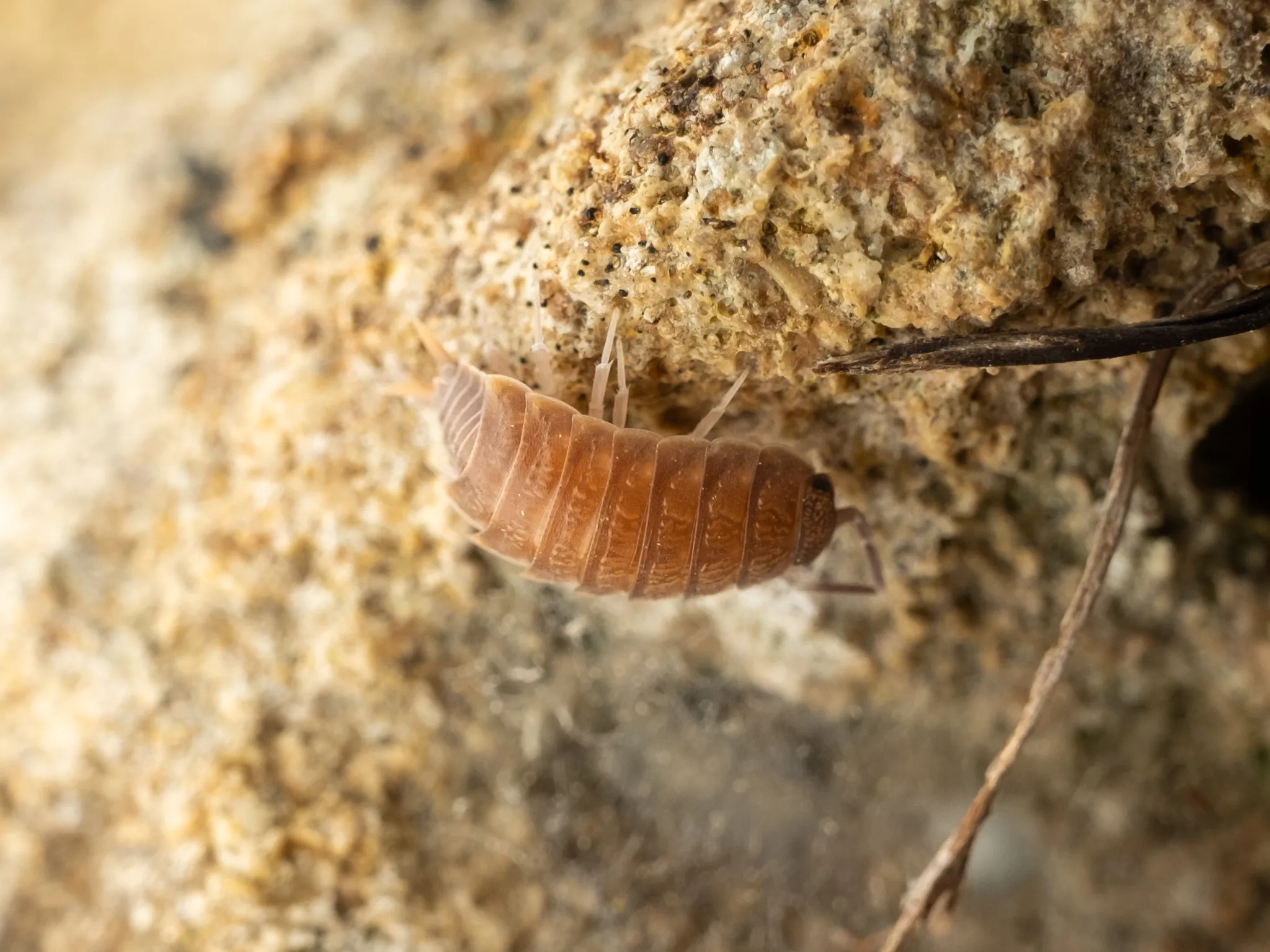 Photo: Alex Abair, CC BY 4.0
In this guide
Short answer: powder orange and powder blue isopods are the same species, Porcellionides pruinosus, in different colors. They’re among the easiest isopods to keep: give them room temperature around 70–82 °F (21–28 °C), humidity of roughly 50–75% with one damp area and one drier area, many small ventilation holes, plenty of leaf litter and rotting hardwood, some protein, and a little calcium. They breed fast, run fast and climb well, so a secure lid matters more than with most species.
Profile
| Scientific name | Porcellionides pruinosus (Brandt, 1833) |
| Older name | Metoponorthus pruinosus |
| Common names | Powder blue, powder orange, plum woodlouse (UK) |
| Adult size | Up to about 12 mm (about 0.5 in) |
| Origin | Described as native to Europe; now found worldwide |
| Temperature | About 70–82 °F (21–28 °C) ideal |
| Humidity | Medium to high, with a moisture gradient |
| Breeding speed | Very fast |
| Rolls into a ball? | No; they run instead |
| Difficulty | Easy |
Powder blue vs powder orange: what’s the difference?
Only the color. Both are sold as Porcellionides pruinosus, and care is the same.
- Powder blue is the wild-type look. The British Myriapod and Isopod Group (BMIG) describes the species as purplish-brown with a blue-grey bloom, contrasting with long whitish legs. Josh’s Frogs says young ones look grey, turn purplish and become steel blue as adults.
- Powder orange is an orange color form. BMIG notes that orange individuals occur rarely in the wild. Smug Bug calls it one of the most common orange mutations in the hobby.
- The “powder” is a waxy coating the isopods produce, according to Smug Bug. It gives them their dusty look.
Breeders have developed more forms of the same species, sold under names such as Orange Cream, White Out and Oreo Crumble. Care is the same for all of them.
A note on taxonomy
The name Porcellionides pruinosus may cover more than one species. Wikipedia describes it as a suspected species complex of very closely related species. Several genetic studies have found deeply separated lineages in wild populations, but we found no full revision of the group. For keepers this changes nothing: cultures in the hobby are all sold and kept under this one name.
Where they come from
In the wild, powders live close to people. BMIG records them mainly in manure heaps, compost heaps and around stables and farm buildings, where they can be abundant. The species has been spread around the world by people and is now found almost everywhere.
That habitat explains a lot about their care: they like warm, rich, decaying organic matter and tolerate a fairly wide range of conditions.
Temperature
| Source | Range |
|---|---|
| The Bio Dude | 72–82 °F ideal, 65–90 °F tolerated |
| Terrarium Tribe | 70–80 °F (21–27 °C), with 65 °F seen as a low end |
Normal room temperature works. In a cold room, place the tub in the warmest spot, but keep it out of direct sun, which can overheat a closed container quickly.
Humidity and moisture
Powders tolerate drier conditions than many tropical isopods, but they still need moisture.
- The Bio Dude: 50–75% ideal, with a moisture gradient and damp retreats. It stresses that they need access to consistently humid microclimates to molt properly.
- Terrarium Tribe: anything above 50% should be fine, with one moist area and one relatively dry area. Moistened sphagnum moss in one corner is an easy way to create the damp zone.
Keep about a third of the substrate damp and let the rest stay just slightly moist. Add water to the damp side rather than soaking the whole tub. If you’re unsure about moisture, see why are my isopods dying.
Housing and ventilation
- Container: a small plastic tub works for a starter group. Upgrade or split the colony as it grows.
- Ventilation: The Bio Dude calls for moderate ventilation. Terrarium Tribe recommends many small holes rather than a few large ones.
- Escape-proofing: powders are fast and decent climbers. Terrarium Tribe calls them “quite the escape artists” and suggests covering holes with fine mesh. See can isopods climb glass.
- Hides: cork bark flats on the damp side. Both Terrarium Tribe and The Bio Dude recommend cork bark, which works as a hide and a long-term snack.
Substrate
For a culture, an organic mix with leaf litter on top works well. Terrarium Tribe suggests coco coir, sphagnum and peat moss, or earthworm castings, a few inches deep. Many keepers use a mix similar to a bioactive substrate with crushed leaves and rotting hardwood mixed in.
Food
| Food | How often |
|---|---|
| Leaf litter (oak, magnolia) and rotting hardwood | Always available; the staple |
| Vegetables (squash, zucchini, carrot, cucumber) | Small amounts, about twice a week in cultures |
| Protein (fish flakes, dried shrimp, isopod protein food) | Regularly, in small amounts |
| Calcium (cuttlebone, eggshell, limestone) | Always available |
Terrarium Tribe says they’ll eat just about anything. Remove fresh food that isn’t eaten within a day or two so it doesn’t mold or attract mites. See what do isopods eat and grain mites in isopod cultures.
On calcium, sources differ in emphasis. Terrarium Tribe notes that powders have softer shells and need less calcium than heavy-shelled species like dairy cows, though they still benefit from some. The Bio Dude recommends keeping a calcium source available at all times. A piece of cuttlebone in the tub covers both views.
Breeding
Breeding is the easy part. Every source we checked calls powders prolific or fast breeders that form large broods. We found no reliable hobby figures for brood size or time to maturity, so we don’t give exact numbers.
What helps a new colony grow:
- Warmth toward the upper end of the range
- A damp zone that never fully dries out
- Regular protein and constant leaf litter
- Not disturbing them too often
The main risk with fast breeders is running out of food. A booming colony can strip a tub of leaf litter quickly, so keep adding more. For general tips, see how to breed isopods faster.
Wikipedia gives a lifespan of about 11–14 months in the wild and two to three years in captivity, but flags the captive figure as needing a better source.
Powders in a bioactive enclosure
Powders are one of the most common cleanup crew isopods. They’re active on the surface and in the upper layers of the substrate, so you’ll actually see them, and they handle a fairly wide humidity range.
They work well in:
- Tropical and semi-tropical setups such as crested gecko enclosures
- Medium-humidity setups with a damp hide or moist corner. The Bio Dude also lists them for arid and temperate terrariums, as long as humid microclimates are available.
Things to keep in mind:
- Delicate animals: Josh’s Frogs warns that, in rare cases, starving isopods may gnaw on small or delicate reptiles or amphibians, and suggests dwarf species such as dwarf whites as a safer option when in doubt. Keeping the crew well fed lowers the risk. See dwarf white isopod care.
- Mixing species: Terrarium Tribe notes that powders are known for quickly establishing themselves in other isopod cultures. In a large enclosure, a mix is common, but in culture tubs keep species separate.
- Predators: if your animal eats isopods, build up a separate culture first and restock as needed.
For other options, see best isopods for beginners and how many isopods and springtails you need.
Frequently asked questions
Are powder orange and powder blue isopods the same species?
Yes. Both are Porcellionides pruinosus. Powder blue is the wild-type color and powder orange is a color form, so their care is identical.
Are powder isopods good for beginners?
Yes. They’re hardy, tolerate a fairly wide range of temperature and humidity, and breed quickly, which makes them one of the easiest species to start with.
Do powder isopods need high humidity?
Medium to high. Aim for roughly 50–75% with one damp area. They tolerate drier air than many tropical species but still need a humid spot to molt.
How big do powder isopods get?
Adults reach up to about 12 mm, or roughly half an inch.
Can powder isopods live with dwarf white isopods?
In a bioactive enclosure, many keepers use both. In culture tubs, keep them apart, because powders tend to take over other cultures.
Sources
- Porcellionides pruinosus (Wikipedia)
- Porcellionides pruinosus (British Myriapod and Isopod Group)
- Powder isopod care sheet (The Bio Dude)
- How to care for powder orange isopods (Terrarium Tribe)
- Porcellionides pruinosus, powder blue (Josh's Frogs)
- The orange mutation in different isopod species (Smug Bug)