Do You Need a Drainage Layer in a Bioactive Terrarium?
When a bioactive terrarium needs a drainage layer, how deep it should be, which materials to use and why arid setups usually skip it.
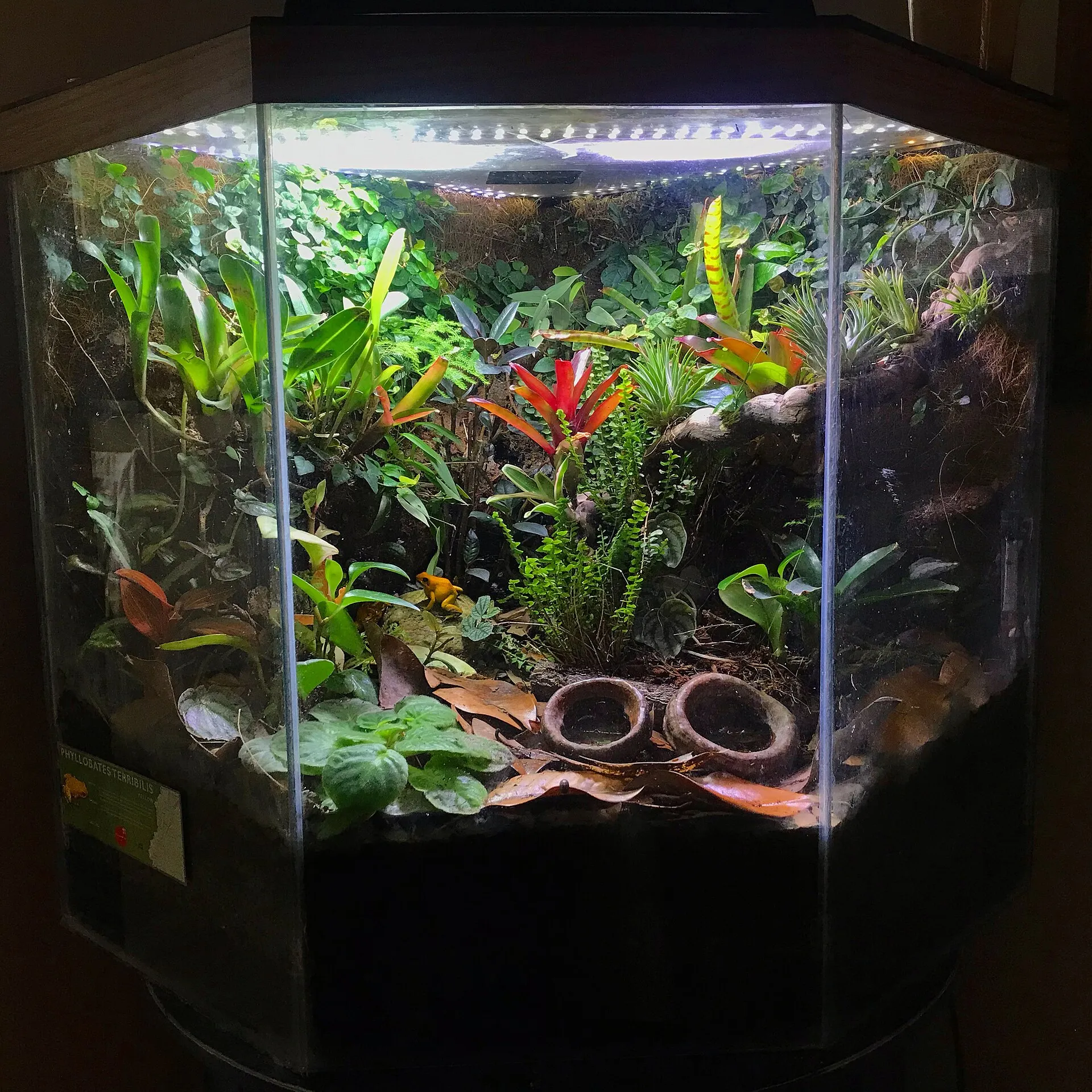 Photo: Connor Long, CC BY-SA 4.0
In this guide
Short answer: in humid tropical setups, yes. A drainage layer of 1–2 in (2.5–5 cm) of clay balls or lava rock, covered by a mesh barrier, keeps water from pooling in the soil and rotting it. In arid setups, usually no, because very little water is added and a drainage layer would mostly take up space.
What a drainage layer does
When you mist a humid enclosure, excess water sinks through the soil. Without somewhere to go, it collects at the bottom and the lowest layer of soil turns into anaerobic mud. That leads to:
- Sour or rotten smells
- Root rot in plants
- Dying isopods and springtails
- Mold and fungus gnats
A drainage layer gives this water a place to collect below the soil. The mesh barrier stops soil from falling in and clogging it.
When you need one
| Setup | Drainage layer? |
|---|---|
| Dart frogs, tree frogs, other amphibians | Yes |
| Crested geckos and other tropical geckos | Yes, recommended |
| Tropical snakes and lizards with regular misting | Yes, recommended |
| Leopard geckos, bearded dragons, other desert species | Usually no |
| Isopod culture tubs | No |
How deep should it be?
- Small enclosures (up to about 18 × 18 in): about 1 in (2.5 cm)
- Larger enclosures, heavy misting or rain systems: 1.5–2 in (4–5 cm)
Deeper is fine, but it adds weight and takes away height from your animal. Our Substrate Calculator shows how much drainage material you need.
Materials compared
| Material | Pros | Cons |
|---|---|---|
| Expanded clay balls | Light, clean, reusable, widely available | Can float when the layer is flooded |
| Lava rock | Cheap, lots of surface area | Heavy, sharp edges can tear the barrier |
| Aquarium gravel | Easy to find | Heavy |
| Plastic “false bottom” (egg-crate grid) | Very light, creates open water space | More work to build |
The barrier matters
The barrier is just as important as the drainage material. Use a fine fiberglass mesh or a purpose-made substrate barrier. Cut it a little bigger than the floor and fold the edges up against the glass so soil can’t sneak down the sides.
Don’t let it flood
The drainage layer only works while there’s room left in it. If the water level rises into the soil:
- Remove water with a turkey baster, syringe or small pump. Some enclosures have a drain port.
- Mist less, or reduce the misting system run time.
- Check that the barrier hasn’t collapsed and let soil in.
Frequently asked questions
Can I use gravel as a drainage layer?
Yes, but it’s heavy. Clay balls or lava rock are lighter and more common.
Can I skip the drainage layer if I use a deep substrate?
In a lightly misted enclosure, a deep, airy substrate can work without it. In a humid setup with frequent misting, skipping it risks waterlogged soil.
Do springtails and isopods live in the drainage layer?
Some springtails will. It’s not a problem, as long as the layer isn’t flooded.
What goes on top of the drainage layer?
A mesh barrier, then the bioactive substrate. See our full step-by-step setup guide.